Explore the World of Chemistry
Britt Johnson
Learn how to become a professional chemist in a few short steps in this blog
Transcript of an Interview of Real Chemists
How would you describe the work of an organic chemist? Is the work that you are doing in your laboratories trying to imitate what nature does in the real world? Is this the right description?
Ryoji Noyori: Not really so.
William S. Knowles: We make big molecules, that’s what nature does and we try to copy nature. And I think big complicated molecules.
And you can find them in nature?
William S. Knowles: Nature is full of them. We’re all great big molecules.
https://www.nobelprize.org/prizes/chemistry/2001/knowles/25923-interview-transcript-2001-2/
Basic Reactions
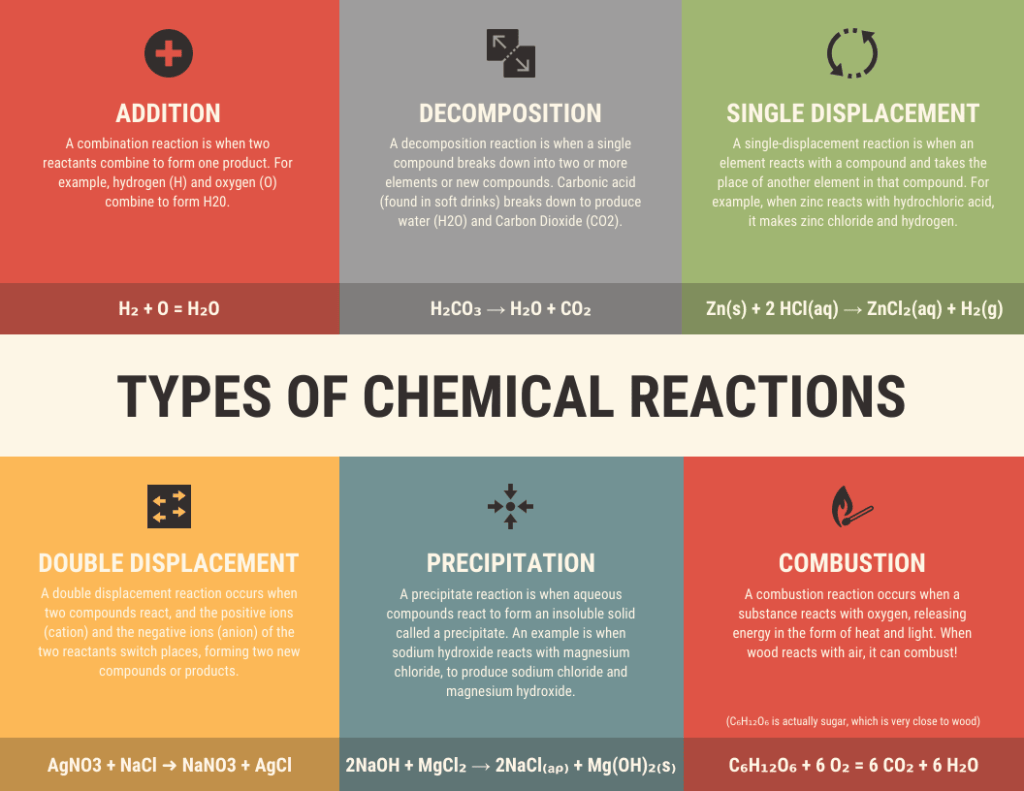
This infographic shows the six types of chemical reactions that occur. This is very useful knowledge for a future as a chemist (especially an organic chemist) because you must understand what reaction is occurring at that given moment in order to carry out an experiment.
Source:
How to Become a Chemist
Here’s how to become a chemist professionally step-by-step and how to land the perfect job:

Education
The first step is to get a bachelor’s degree in the field of chemistry you are interested in. Some companies require a higher education, especially if you are pursuing research.
Experience
It is important to get experience in the field you are trying to pursue. Internships or research for a professor at a university are good ways to get that experience before applying for the real-deal jobs.

Resume Building
This last step ties in to the “Experience” category via internships and research because many companies will look for that experience on your resume when they are hiring. More options for resume building would be to get letters of recommendation from old professors you had as an undergraduate or graduate student.
https://www.prospects.ac.uk/careers-advice/what-can-i-do-with-my-degree/chemistry
 React With Science